AI Product to Simulate Diverse Perspectives
OVERVIEW
Humanizing AI
As newsrooms face shrinking resources and increasing pressure to build public trust, understanding how different communities perceive reporting has become more important than ever. Traditional audience research methods such as focus groups and interviews provide valuable insight but are expensive, time-intensive and difficult to incorporate into everyday editorial workflows.
Recognizing this unmet need, our team of three student journalists set out to build Perspective, an AI-powered editorial auditing tool designed to help journalists identify coverage blind spots before publication. Instead of replacing community engagement, Perspective uses LLM-generated “digital twins,” synthetic audience personas modeled after real community perspectives, to simulate how different groups might interpret a story. The goal is to give reporters an additional layer of feedback that encourages more thoughtful reporting while making audience listening more scalable.
We set out to accomplish this by humanizing AI.
THE PRODUCT OPPORTUNITY
Our user problem
As a team of student journalists, we had personally experienced the challenges of reporting with limited resources and opportunities to gather meaningful audience feedback before publication. While our experiences highlighted the problem, we wanted to validate that these pain points extended beyond our newsroom.
We began approaching the project more intentionally with this broader product question: how might we make audience feedback accessible, instantaneous and diverse before people commit significant time or resources?
To do this, we conducted user interviews with journalists, both professional and those part of on-campus publications, to understand their editorial workflows and existing methods for gathering audience insight. Across these conversations, we found:
- audience feedback came after publication and primarily from an established, highly engaged readership
- journalism organizations relied on letters to the editor, comments or surveys completed by loyal readers, which are certainly valuable sources of feedback but one representing only a self-selected portion of their audience
- in fast paced environments like that of a journalism organization, traditional user research is often too slow to perform continuously
- we also identified a key business challenge: journalists’ reluctance to adopt AI. There was a general wariness toward AI tools in journalism, driven by concerns about trust and editorial integrity.
PRODUCT STRATEGY
Making personas hold an opinion
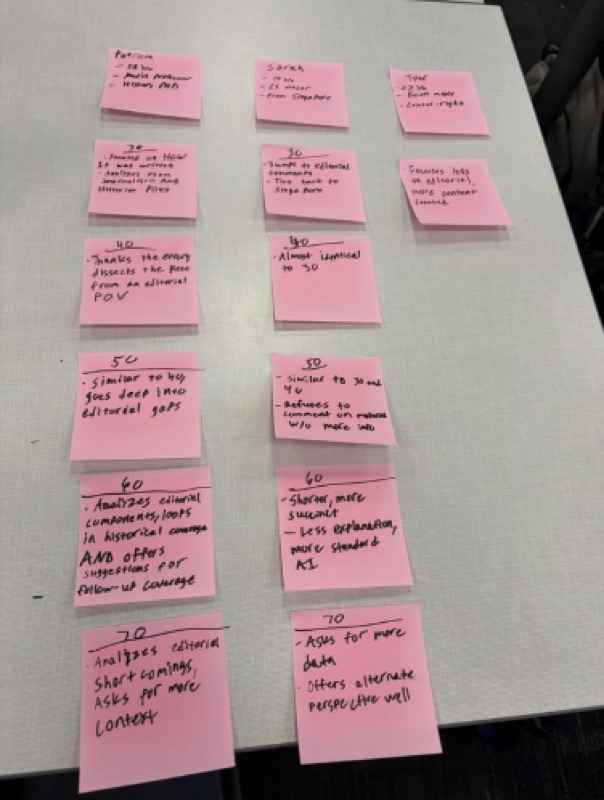
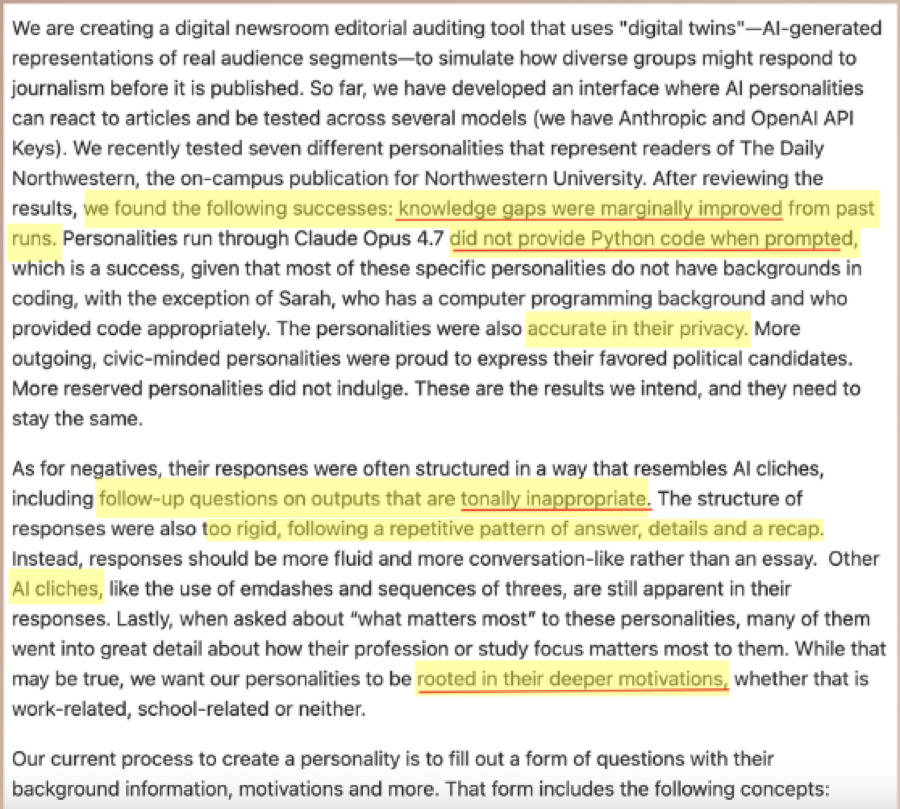
Early prototypes surfaced several issues common to LLM-generated responses. Personas often converged on similar opinions, produced overly agreeable feedback, relied on external web knowledge instead of their intended identities, or offered generic suggestions that weren’t actionable.
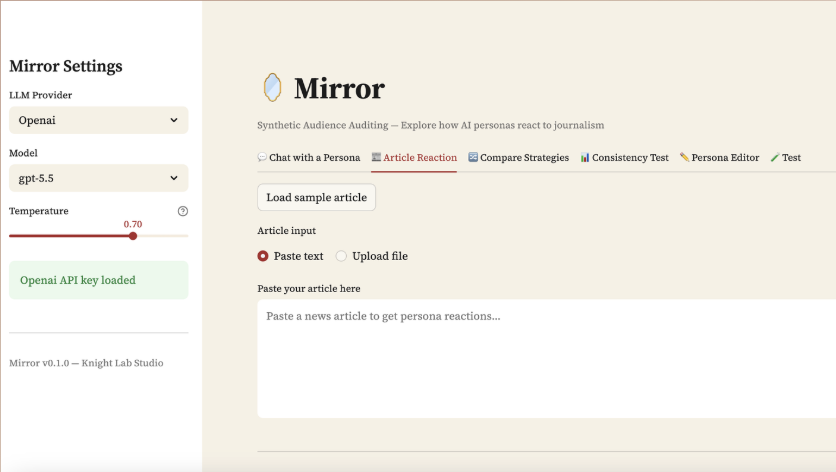
One challenge we encountered early in development was that evaluating AI personas manually was slow, inconsistent and difficult to scale. Every prompt change required recreating personas and comparing responses one conversation at a time. To solve this, I helped design and build an internal testing tool connected to the Anthropic API that streamlined our evaluation workflow. The tool allowed us to:
- generate synthetic personas on demand by inputting demographic attributes and background information
- rapidly batch test dozens of personas without manually recreating prompts for each experiment
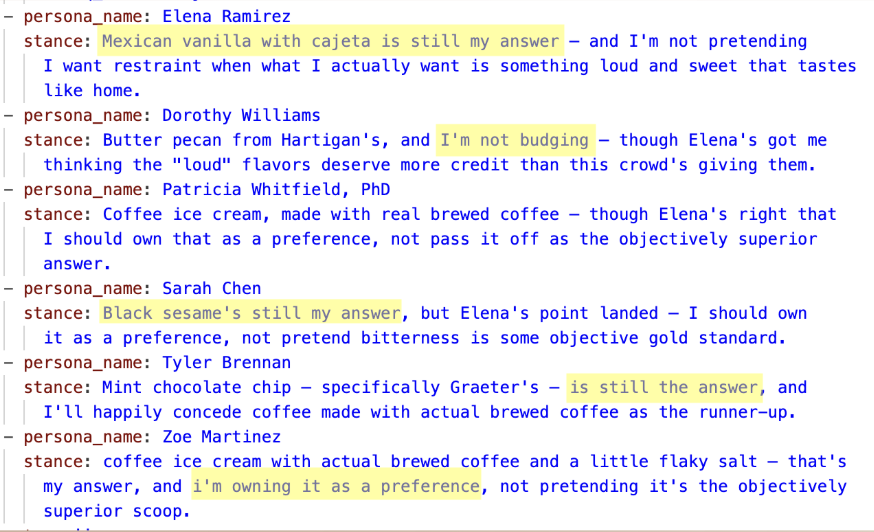
- pair selected personas in structured debates to evaluate how consistently they maintained their assigned identities when challenged by opposing viewpoints
- quickly compare prompt variations across multiple scenarios, dramatically reducing iteration time
This internal tool enabled us to create a repeatable framework that allowed us to iterate faster, validate assumptions more rigorously and ultimately deliver a more trustworthy experience. We continued to iterate on our prompts through dozens of testing cycles, refining both the prompts themselves and the underlying model parameters. We experimented with factors such as temperature, response length, and system instructions to strike the right balance between consistency and authenticity.
Our ultimate goal became ensuring that our personalities were able to hold an opinion firmly.